
How Ethos' Brand AI Auto Writer Helps Teams Create On-Brand Content Automatically

The Content Creation Bottleneck Nobody Expected
You built your brand guidelines. Your team knows how to sound like your brand. Your voice is documented. Your tone is clear.
But you have 200 pieces of marketing content to create this quarter. And half your team does not feel confident writing in a brand voice. So every email subject line, every product description, every social post goes through your one brand-savvy team member for approval.
That person is drowning. Your content calendar is backed up. You are missing opportunities because you cannot produce content fast enough.
This is not a guideline problem. Your guidelines are fine. This is an execution problem. You need to help teams write faster while maintaining consistency.
This is the problem Ethos' Brand AI Auto Writer was designed to solve.
Why AI for Brand Voice Actually Makes Sense
Your first instinct might be skepticism. AI and brand voice sound like they should not mix. Brand voice is personal. Specific. Human.
But here is the reality: AI trained on your actual brand guidelines and real examples from your content can generate starting points that teams refine, not finished pieces that teams publish as-is.
Think about it differently. Your guidelines are instructions. Your past content is examples. Your brand voice is a pattern. Feed an AI system your guidelines and examples, and it learns your brand patterns the way a new team member would learn them, except faster.
Design research on AI-assisted writing shows that teams using AI for first drafts produce more consistent output, not less. Why? Because the AI constrains itself to learned patterns. It does not wander off brand the way humans sometimes do when they are tired or rushing.
The catch is this: the AI is only as good as the guidelines and examples you feed it. Weak guidelines produce weak output. Strong guidelines produce strong output.
What Brand AI Writer Actually Does
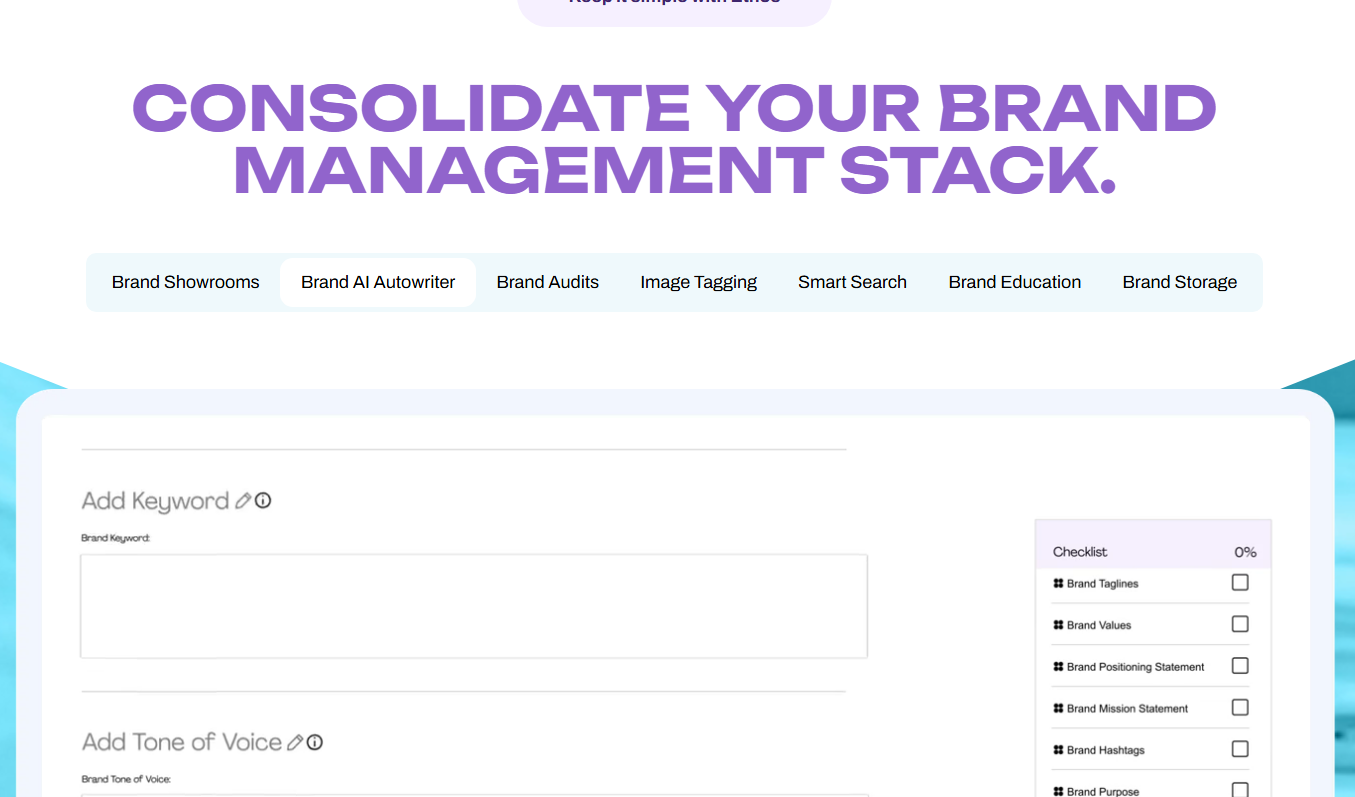
Ethos' Brand AI Writer is not trying to replace your writing team. It is trying to augment them.
Here is the actual workflow:
Step 1: Train on Your Brand
You connect your brand guidelines and feed the system recent content examples. Product descriptions from your website. Email copy. Social posts. Customer testimonials. The system learns patterns: how you structure sentences, what vocabulary you favor, how you handle different tones across contexts.
This training takes minutes, not hours. You are not manually coding rules. You are showing examples and letting the system identify patterns.
Step 2: Generate Starting Points
A team member needs to write an email subject line. Instead of staring at a blank page, they input what the email is about. The system generates three to five subject line options that sound like your brand.
Same for product descriptions. Same for social posts. Same for help documentation. The system knows your voice and generates options that feel on brand.
Step 3: Review and Refine
The team member reviews generated options. Picks the strongest one. Edits as needed. What would have taken 30 minutes to write from scratch now takes 10 minutes to refine.
More importantly, the team member never gets lost exploring off-brand directions. Every starting point sounds like your brand.
The Real Results Teams See
Faster Production
Teams report 40 to 60% reduction in writing time for routine content. Not because AI replaces thinking. But because the starting point is already on brand. Less time spent rewriting. More time spent on refinement and strategy.
Higher Consistency
When every first draft is on brand, final output is more consistent. Teams spend less time worrying about whether they sound right and more time worrying about whether the message is right.
Lower Brand Approval Friction
Content coming from the AI is already trained on your guidelines, so approval cycles are faster. Brand managers do not have to rework fundamental tone. They review for strategy and accuracy, not voice.
Team Confidence
Team members who feel uncertain about brand voice suddenly feel more confident. They have a safety net. The AI helps them stay on track. One brand manager describes it as "training wheels for brand writing."
A Realistic Day in the Life
Let us follow a product marketing manager through her day using Ethos' Brand AI Writer.
9:00 AM: She needs to write product descriptions for three new features launching next week. Instead of spending an hour writing from scratch, she inputs feature details into the AI. The system generates descriptions in her brand voice.
She reads the three options for the first feature. One option is too technical. One is too casual. One is just right. She edits it slightly for accuracy and moves on.
Three features that would have taken an hour now took 15 minutes. Same quality. Definitely on brand.
11:30 AM: She is writing an email to customers about a service update. The update is not ideal news. She needs the tone to be transparent but reassuring. She feeds this context to the AI.
The system generates options that maintain her brand voice while hitting the emotional notes she needs. She picks one, personalizes it slightly, and sends it.
Without the AI, she would have agonized over tone. Is this honest enough? Reassuring enough? Brand appropriate? The AI helps her navigate these decisions faster while staying on brand.
2:00 PM: She is writing social media copy for a campaign. She uses the AI to generate starting points. She edits them for platform specifics and campaign nuance. By 3:00 PM, she has six social posts that sound cohesive and on brand.
Her brand manager reviews them. Usually this takes 30 minutes of back and forth. Today it takes 10 minutes because they are already on brand. Feedback is about strategy, not voice.
The Surprising Limitation That Actually Matters
Here is what brand AI writer cannot do: it cannot understand context the way humans do.
Your brand voice might shift based on audience. You sound different talking to Fortune 500 enterprises than to solo entrepreneurs. The AI learned your patterns, but it does not inherently understand these contextual shifts without explicit instruction.
This is actually a feature, not a bug. It means you have to think through your brand voice rules for different contexts. This forces clarity. Many teams discover they do not have clear voice guidelines for different audiences. That clarity becomes valuable.
The AI also cannot generate breakthrough ideas. It works within patterns you have shown it. If you need something that breaks your brand guidelines intentionally, the AI cannot help. You need a human for that.
Technical Setup: It Is Simpler Than You Think
Ethos' Brand AI Writer integrates directly into the brand platform. There is no complicated setup. Here is what it takes:
1. Connect Your Guidelines
Upload or link your brand guidelines document. The system scans for voice, tone, and messaging frameworks.
2. Add Example Content
Point the system to your content library or paste examples directly. Five to ten examples per content type is usually sufficient. Product descriptions, email copy, social posts, help text. Different types get trained separately.
3. Configure Contexts
If your voice shifts by audience or context, label your examples accordingly. "This is a customer-facing friendly tone." "This is a technical documentation tone." "This is a marketing promotional tone."
4. Start Generating
That is it. You are ready to start using AI to generate on-brand content.
When Brand AI Actually Works and When It Does Not
This works really well for:
Routine content where consistency matters but creativity is not the primary goal. Product descriptions. Email templates. Social media variations of core messages. Help documentation. FAQ responses. Internal communications.
These categories represent 60 to 70% of what most marketing and product teams write. The AI excels at these.
This is less useful for:
Content that requires breakthrough thinking or radical positioning shifts. Campaign concepts. Brand positioning statements. Deep strategic content. Anything where you need to break your established patterns intentionally.
For these, humans should lead and AI can support, but the AI will not be the primary tool.
The Honest Tech Limitations
AI language models are not perfect. Sometimes generated content is awkward. Sometimes it misinterprets context. Sometimes the options feel generic despite being on brand.
This is why the workflow includes review. The AI generates starting points, not final content. You review and refine. This hybrid approach is where the value actually lives.
Also, AI models reflect training data patterns. If your past content has subtle biases, the AI might amplify them. This is why choosing good examples to train on matters. If you train on diverse, high quality content, output improves.
How This Connects to Larger Brand System
Ethos' Brand AI Writer works because it sits within a larger brand system. The guidelines are connected. The approved content is connected. The asset management system is connected.
A product description generated by the AI automatically links to related assets. Brand managers can audit what the AI is generating to catch patterns or problems early.
This integration is what prevents AI from creating brand chaos. The AI is constrained by the system, not free-floating in the internet.
A Scenario: Rolling Out AI to Your Team
Your brand team decides to implement Ethos' Brand AI Writer. Here is how it might unfold:
Week 1: Your brand manager sets up the AI, uploads guidelines, and adds 20 content examples across four categories. She tests it herself to understand how it works.
Week 2: She trains your marketing team in a 30-minute session. Here is what to input. Here is what you get back. Here is what good refinement looks like. The team is skeptical but curious.
Week 3: Your product team starts using it for product descriptions. They are amazed at how consistent output is. A junior writer who usually needs extensive feedback now gets minimal feedback. She feels more confident.
Week 4: Your customer success team starts using it for support emails. Response quality is faster and more consistent. Your support manager notes that customer satisfaction scores on support interactions actually improve.
Month 2: You have usage data. The AI is generating 200+ pieces of content monthly. Your brand manager spot checks and finds quality is high and consistency is strong. A few patterns emerge where the AI is slightly off-brand. She adjusts guidelines and retrains.
Month 3: Usage becomes routine. Teams stop thinking of it as special. It is just how they generate starting points now. The brand manager spends less time on routine approvals and more time on strategy.
The Broader Implication
AI for brand writing is not about replacing human judgment. It is about removing friction from the parts of brand execution that should be fast and consistent.
When your team spends 30 minutes writing a product description, they are not doing anything a brand-trained AI cannot do faster and more consistently. That 30 minutes should be spent on strategy or creativity.
When an approver has to spend 20 minutes rewriting routine copy into brand voice, that is friction that should not exist.
AI does not fix broken brand strategy. Weak guidelines do not become strong through AI. But strong guidelines? AI helps execute them faster and more consistently across teams.
If routine content generation is a bottleneck for your team, explore how AI-assisted writing could help. Start small. Test with one content type. Do product descriptions or social posts.
You will learn quickly whether this fits your workflow.
To see how Ethos' Brand AI Writer integrates with broader brand asset management and guideline systems, explore the full brand assets management solution that keeps AI-generated content on brand and connected to your system.

11 Brand Guidelines Examples That Every Growing Brand Should Study
How to Assess What Your Brand Is Missing: Strategies for Managers

The Top Tool for Sharing Interactive Brand Guidelines With Teams
.svg)


