
Why Brand Guidelines Get Ignored and How to Digitize Them

The silent question that exposes the whole problem
What is the point of brand guidelines if no one ever uses them! Everyone agrees brand consistency matters. CMOs care about protection and clarity. Designers want rules they can trust. Founders want a brand that feels unified. Agencies want a north star. Yet in most companies, the brand guidelines become a forgotten PDF, saved somewhere between old pitch decks and outdated press kits.
The truth is simple. Traditional guidelines were never built for modern marketing. Teams move fast, channels multiply, and assets evolve constantly. A static PDF cannot keep up with real-world execution. Digital brand guidelines solve this by giving teams something they can actually use daily, inside the tools and workflows they already live in.
The outdated PDF problem
PDF-based guidelines fail not because people ignore them, but because they do not fit the reality of how teams work today. The format itself creates friction and confusion before anyone even reaches the content.
PDF guidelines suffer from several built-in issues
- They cannot update themselves. Once exported, they become outdated as soon as your logo, messaging, or layouts evolve. You end up emailing “new versions” that compete with the old.
- They are not searchable in a practical way, so people scroll endlessly to find a single rule. It becomes faster to guess than to check, which is how off-brand work starts.
- They rarely contain direct download links for assets or templates. Teams read the rules but still need to chase files, slowing momentum and creating unnecessary back-and-forth.
- They rely on manual re-sharing every time something changes. Different teams save different copies, making it impossible to maintain a single source of truth.
- They live outside daily tools like Figma, Google Drive, or project management apps. If opening the guidelines becomes a separate task, they will always be used less.
- They confuse more than they guide as teams scale across regions and product lines. People become unsure which sections apply to them, so they improvise.
PDFs were designed for static reference, not for fast-moving, multi-channel collaboration. That is why they start strong during a rebrand and then slowly fade out of daily use.
Digital brand guidelines remove version chaos
Digital brand guidelines turn your brand from a static document into a living system. They connect rules, examples, and assets in one place, so teams are never guessing which file or instruction is correct.
What digital brand guidelines fix immediately
- One source of truth that updates automatically for everyone. When you change a logo or rule once, it is reflected across the entire system, so there is no more version roulette.
- No more hunting for logo files, hex codes, or templates buried in email threads. Teams know exactly where to go for the latest approved assets.
- Instant access for internal teams, agencies, and freelancers through secure links. You do not have to repeatedly attach the same guidelines in every project brief.
- Searchable rules with clear examples for specific scenarios, such as social ads, email headers, or presentation covers. People can quickly find what applies to their task.
- Easy onboarding for new hires and partners, who can learn the brand by exploring a live hub instead of reading a dense PDF. This shortens ramp-up time.
- Clear permissions so different teams see the sections and assets that matter to them. That avoids overwhelming users with irrelevant details.
This shift transforms decision-making from “ask someone and hope” to “check the brand hub and act.” It is a big operational upgrade disguised as a design improvement.
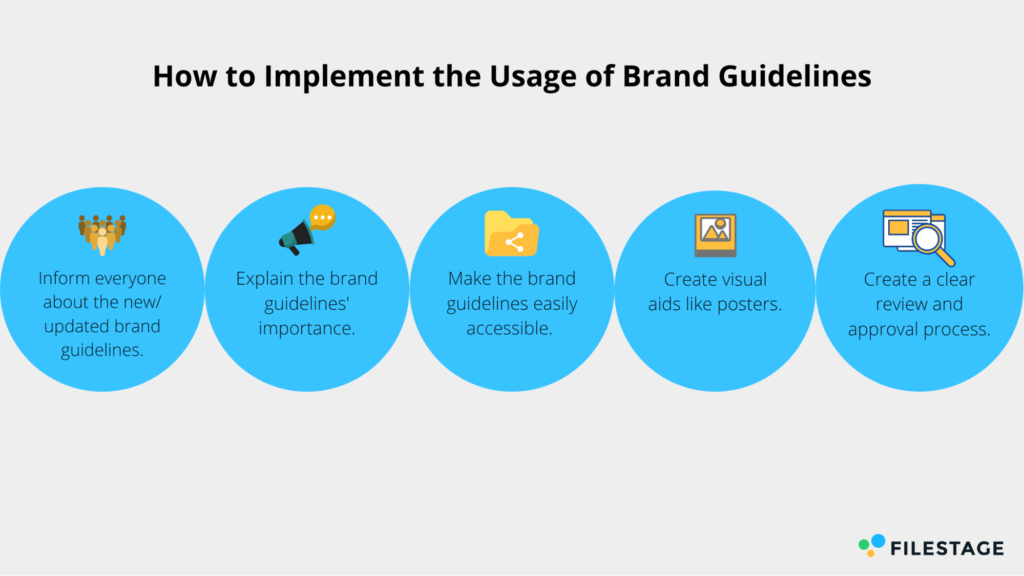
How brand guidelines end up collecting dust
When guidelines fail, it is usually not because the content is bad. It is because the structure and format do not match how people actually work under pressure.
1. The document is too long and too dense
Teams get overwhelmed when guidelines turn into a textbook instead of a tool. Long PDFs look impressive in a rebrand presentation, but are painful in day-to-day use.
Why long guidelines fail
- No one has thirty minutes to dig through pages while a campaign deadline is approaching. People default to shortcuts, templates they already have, or whatever was used last time.
- Readers skip sections, skim quickly, or abandon the document altogether. That leads to inconsistent interpretations of tone, spacing, layout, and color usage.
- Real examples are often buried or missing, so rules feel abstract. Designers see “do not stretch the logo,” but no real before-and-after context to guide nuanced decisions.
- Teams fall back on improvisation because following the rules is slower than guessing. Once improvisation becomes normal, the guidelines lose authority.
Effective guidelines should feel like a fast reference map, not a heavy manual. When every answer is buried under layers of theory, usage drops.
2. Too many versions floating around
Version chaos is one of the biggest killers of brand consistency. The more copies you have, the less anyone trusts which one is right.
How version chaos shows up
- Multiple logo files exist with different spacing, colors, or backgrounds. Some sit on old agency drives, others in random presentation decks. Teams pick whatever they find first.
- Outdated color palettes and fonts are reused because they were saved locally in older projects. Designers may not even know they are working with outdated styles.
- Tone of voice shifts depending on who last edited the copy. Without a central, updated guide, each writer or agency uses their own interpretation of the brand voice.
- Agencies store old assets from previous campaigns and reuse them by habit. They are not being careless; they simply do not have an obvious way to confirm what is current.
Once more than one version of “official” exists, people start relying on memory, past projects, and convenience. At that point, guidelines stop being a source of truth.
3. The guidelines do not match the real execution
Many guidelines look beautiful but do not reflect the real formats and tasks teams handle every day. The gap between theory and practice becomes a constant problem.
Execution problems include
- No downloadable assets directly linked to the rules. People see how the logo should look, but still need to ask a designer to export it for different platforms.
- No approved templates for social media, email campaigns, ads, or decks. Teams then create their own versions, which slowly drift away from the core design system.
- No rules for edge cases like square avatars, app icons, motion intros, or vertical video crops. Teams improvise solutions that are close but not quite aligned.
- No adaptation for different markets, languages, or product lines. Local teams adjust wording, layouts, and images on their own, which fragments the brand over time.
No instructions for evolving campaign styles such as seasonal themes or special launches. Temporary creative experiments accidentally become permanent.
Teams need guidance that lives where they work and speaks to the formats they use every day. Abstract pages about “brand personality” are not enough on their own.
4. The brand evolves, but the guidelines stay frozen
Modern brands are rarely static. New products, markets, and partnerships keep changing how the brand shows up. Static guidelines simply cannot keep up.
When guidelines cannot keep up
- New product lines launch with their own visual twists and messaging, yet the guidelines do not explain how they sit under the master brand. Teams improvise structure.
- New markets require new examples, phrases, and cultural considerations. Without updates, local marketers end up bending the rules or ignoring them entirely.
- New design trends and platform changes push teams to adopt formats like short-form video, dark mode, or interactive content. Guidelines stay focused on print and static layouts.
- New platforms appear and demand fresh asset specs, file sizes, and design patterns. If the guidelines are never updated, they slowly lose relevance and authority.
If the brand is moving but the guidelines are not, people stop seeing the guidelines as a live reference and start treating them as history.
Why CMOs need digital brand guidelines
CMOs are accountable for brand strength, recognition, and performance. They need more than a nice-looking PDF; they need a controllable system that supports measurable outcomes.
Digital systems give CMOs clarity through
- Real-time control over updates and asset versions. When strategy shifts, the brand system can reflect a new direction within hours instead of waiting for the next redesign.
- Usage analytics that show which teams and regions are engaging with the brand hub. This makes it easier to see where training or reinforcement is needed.
- Faster campaign approvals because everyone references the same rules. Creative reviews become about big ideas, not tiny brand errors that should never reach that stage.
- Less rework, which reduces creative spend and agency hours wasted on fixing avoidable inconsistencies. This protects both budget and team energy.
- A stronger brand presence across all customer touchpoints, because every team is pulling from the same well-maintained standard. That consistency compounds over time.
For CMOs, digital brand guidelines turn “brand governance” from something vague into something they can actually monitor, improve, and defend with data.
Why startup founders benefit from digitized guidelines
Founders need speed without losing identity. They often work with lean teams and multiple external partners, so clarity matters even more.
Startup-friendly advantage
- Easy sharing with freelancers, agencies, and new hires through one link. There is no need to resend files or explain the brand from scratch every time.
- Ready to use brand guideline templates for pitch decks, investor updates, landing pages, and social posts. This helps non-designers create on-brand materials without bottlenecks.
- Instant updates so the brand can evolve quickly in response to market feedback. When the messaging tightens, the system updates, and everyone sees the new direction.
- No need for long onboarding sessions just to explain basics like logos, fonts, and color usage. People can self-serve by exploring the hub and following examples.
- A clear identity that stays consistent even as the company pivots, adds products, or experiments with new growth channels. This builds recognition faster.
Digital brand guidelines give founders a quiet advantage. They can scale visibility and credibility without spending all their time policing the brand.
Why design teams rely on digital brand systems
Designers want to protect the brand design while staying efficient and creative. A digital system supports both goals by providing structure without unnecessary friction.
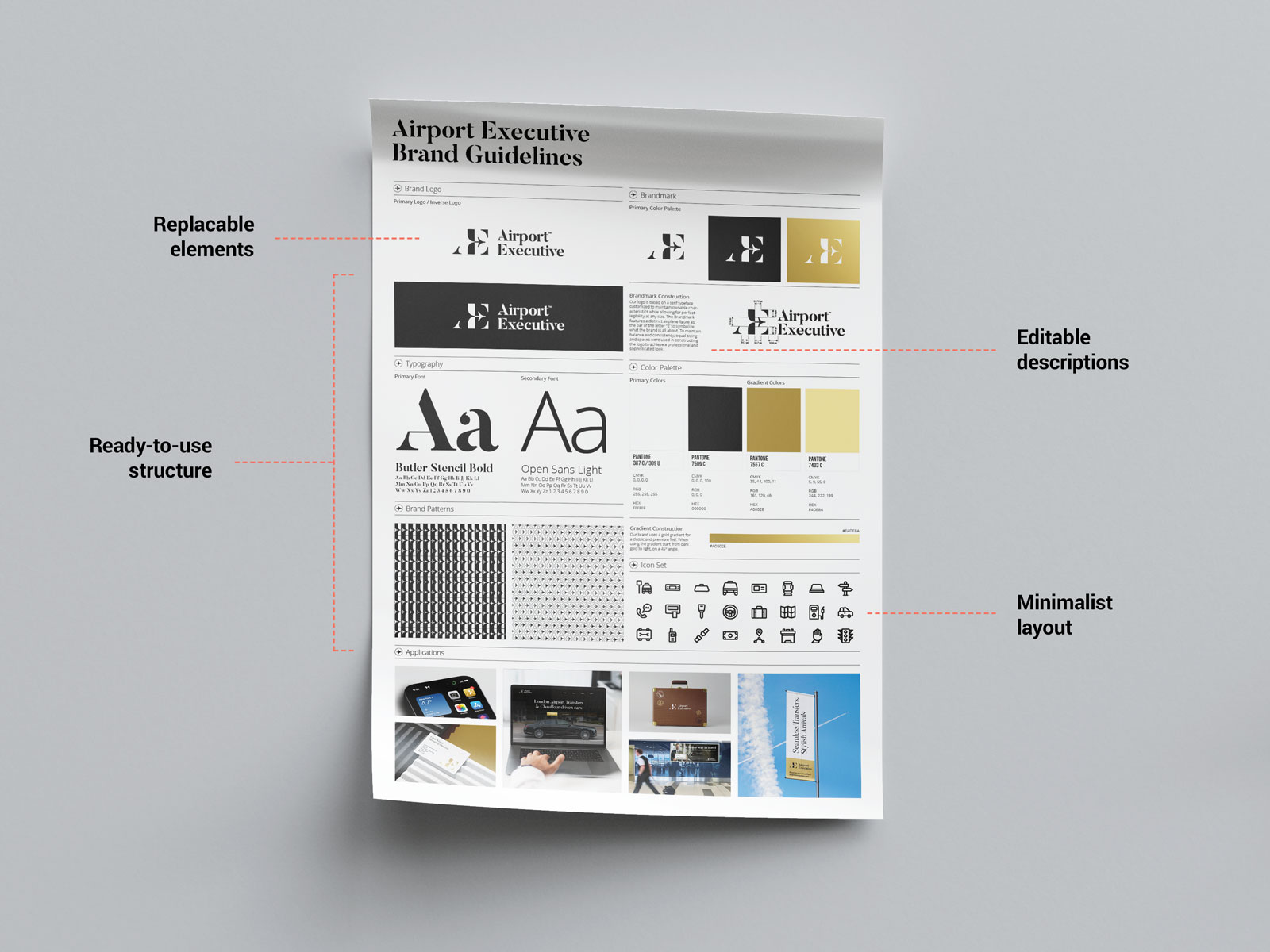
Design teams benefit through
- Centralised component libraries that they can reuse across campaigns and products. This keeps design consistent while speeding up production.
- Clear rules for spacing, typography, motion, and imagery that are easy to reference. Designers do not need to dig around or rely on memory for core principles.
- Faster handoffs to developers and other designers, because everyone uses the same styles, grids, and asset sources. This reduces misunderstandings and rebuilds.
- Clean version management so there is no confusion between “old logo,” “new logo,” and “temporary logo from last quarter’s test.” Only the approved assets stay visible.
- Better integration with design tools such as Figma or Adobe, where library elements and guidelines can sit alongside active design files. This keeps the brand close to the work.
For design teams, digital brand guidelines feel less like regulations and more like an organised toolkit they can rely on.
Why marketing managers need digital brand playbooks
Marketing managers live in the middle of deadlines, campaign launches, and cross-team expectations. They need speed, clarity, and assets that simply work.
Daily operational benefits
- Quick access to approved templates for ads, emails, landing pages, and organic content. They can launch faster without waiting on custom builds for every new idea.
- Clear tone of voice guidance with examples for headlines, calls to action, and long-form copy. This helps non-writers stay on brand without constant reviews.
- Reduced dependency on designers for small tasks such as resizing logos or pulling icons. They can grab what they need directly from the hub.
- Faster campaign deployment because the basic questions are already answered inside the digital guidelines. Conversations can focus on strategy instead of file logistics.
- Easy sharing of brand materials with vendors, partners, and platforms. Everyone works from the same space instead of passing around half-completed folders.
With a digital system, marketing managers get to spend more time planning impact and less time chasing assets.
Why CFOs care about brand governance when it is digital
CFOs rarely get excited by colors or fonts, but they do care about waste, risk, and efficiency. Digital brand guidelines touch all three.
Cost-saving advantages
- Less rework because teams are not constantly fixing off-brand assets or redoing campaigns that missed the mark. This translates directly into hours saved.
- Better campaign performance when the creative is consistently aligned with the brand. Stronger brand recall often lifts conversion rates across channels.
- Lower operational inefficiencies caused by asset hunting and manual corrections. When people can find what they need, less time is spent on admin.
- Clear documentation of rights, usage rules, and standards that reduce legal and compliance risks. There is less chance of using unlicensed or outdated visuals.
- Fewer brand mistakes that require high-profile corrections, print re-runs, or emergency design work. That protects both budget and reputation.
Digital brand guidelines make it easier for finance leaders to see branding as a structured asset, not just a creative cost.
Why agencies and freelancers thrive with digital brand guidelines
External partners do their best work when expectations are clear. Digital guidelines make it easy for them to align quickly without endless clarification emails.
Agencies benefit from
- Easy access to the right logo, font files, imagery, and design rules from day one. This keeps work on track from the first draft instead of going through multiple corrections.
- Fewer revision cycles caused by minor brand alignment issues. Feedback becomes more about strategic direction than basic brand fixes.
- Faster approvals since the client can see work clearly follows the agreed brand system. Trust grows over time when creative lands correctly.
- Clear expectations for layout, hierarchy, and messaging, which helps copywriters and designers collaborate smoothly inside the agency team.
- Smooth onboarding for new people inside the agency, who can self-educate on the client’s brand using the same digital guidelines. This reduces ramp-up time.
For agencies, a good digital brand hub is a sign that the client is organised, serious, and ready to work at a higher level.
Why modern brands require real-time brand governance
Brands no longer live in a handful of channels. They appear in dozens of formats, from social clips to sales decks to internal dashboards. Governance has to keep up.
Modern marketing requires
- Instant updates when a campaign direction shifts or a new product launches. Waiting months to refresh the brand PDF is not realistic anymore.
- Centralised visibility so leaders can see how the brand appears across different teams, countries, and channels. This helps catch misalignment early.
- Cross-team collaboration where design, marketing, product, and sales all draw from the same guidelines. Digital hubs make this collaboration possible.
- Multi-format consistency that holds together across static, motion, interactive, and experiential touchpoints. Rules need to cover all of these spaces.
- Detailed guidance for digital-first experiences, such as apps, web platforms, onboarding flows, and performance ads. These require more than simple logo placement rules.
Real-time governance is only possible when the brand system itself lives in a real-time, digital environment.
The shift from brand guidelines to brand systems
The strongest brands treat their identity as a system that can adapt and scale. It is not just “what the logo looks like” but how everything works together.
A brand system includes
- Rules that adapt as the brand evolves, rather than being rewritten from scratch each time. This creates continuity instead of constant reinvention.
- Components that can be reused across websites, apps, decks, and campaigns. These act like building blocks that keep everything feeling familiar.
- Templates that reflect real use cases such as newsletters, ad sets, and proposals. Teams start from a strong base rather than reinventing layouts each time.
- Dynamic updating so everyone sees the latest version of guidelines and assets without manual distribution. This eliminates guesswork about what is current.
- Clear permissions so different teams, regions, and partners have access to exactly what they need, while sensitive or unused assets remain hidden.
This system-based approach is how large consumer brands maintain a consistent identity at a global scale without grinding daily operations to a halt.
How digital brand guidelines improve collaboration
When everything is centralised and clear, collaboration stops being painful and starts being productive. Teams can finally align on details without endless negotiation.
Teams align better because
- Designers understand expectations and do not feel like they are defending the brand from every side. The rules have already been agreed upon.
- Marketers know what is approved and can brief agencies, writers, and production teams with confidence. This keeps projects moving forward.
- Agencies do not guess or improvise when they are unsure. They can check the digital hub and proceed based on concrete guidance.
- Executives have oversight into how the brand is actually being used. They can ensure the external reality matches the internal strategy.
- Stakeholders trust the process more because they see consistency in how guidelines are applied over time. This reduces subjective debates.
Collaboration improves not because people suddenly change, but because the system makes the right decisions easier to follow.
Case study insights from US-based brands
Digital brand guidelines are already producing measurable gains for brands that adopted them early. These examples show how simple structural changes create real results.
Real examples include
- A fitness brand in Texas cut rework hours by half after centralising assets and rules. Designers stopped recreating elements, and marketing teams stopped using outdated files.
- A California-based property company reduced campaign delays by giving marketing managers direct access to ready-made templates. They no longer waited days for basic layouts.
- A New York ecommerce brand improved ad performance when all creatives started following the same visual hierarchy and tone of voice. Customers recognised the brand faster across platforms.
In each case, the win was not just “better looking design.” It was faster execution and stronger outcomes rooted in consistent brand delivery.
Why digital brand guidelines increase ROI
Brand consistency is not a fluffy concept. It shows up in performance, trust, and long-term growth. Digital brand guidelines help lock that consistency in.
Digital brand guidelines improve ROI by
- Keeping every touchpoint aligned so customers get a coherent experience from ad to website to email to sales deck. That builds familiarity and trust.
- Reducing creative waste on assets that have to be redesigned or corrected repeatedly. Those saved hours can be redirected to higher-value work.
- Improving campaign performance, because on-brand creative tends to convert better than random or inconsistent visuals. It feels more professional and reliable.
- Creating a confident identity that stands out in competitive spaces. This makes it easier for customers to recognise and remember you over time.
- Supporting faster internal processes, which means teams can test, learn, and iterate on more campaigns in the same period of time. More shots on goal usually mean more wins.
When the brand becomes easier to apply correctly than to break, ROI follows naturally.
What digital brand guidelines contain
A fully digitized brand system goes far beyond a PDF of logo pages. It becomes the central hub for everything related to how the brand looks, sounds, and behaves.
A complete system includes
- Visual identity rules that cover logos, spacing, background, and combinations. This gives concrete direction for different real-world placements.
- Typography and color codes with usage guidance for headings, body text, highlights, and accessibility. Teams know when and where each style belongs.
- Photography and illustration guidelines that define mood, subject matter, framing, and editing. Creators can produce assets that actually feel on brand.
- Iconography and motion rules that explain how smaller graphic elements and animations should behave. This keeps digital experiences consistent and polished.
- Brand personality and tone of voice documented with examples. Writers and non-writers can align on language without long training sessions.
- Messaging pillars that outline core stories and key value propositions. These serve as anchors for campaigns and product launches.
- Templates and asset packs for decks, ads, social posts, and internal documents. Everyone can start from a pre-approved base instead of inventing layouts.
- Component libraries and design systems that support product, app, and web teams. UI stays aligned with the brand identity rather than drifting away.
- Regional adaptations and localised patterns that respect cultural differences while keeping the core brand intact. Local teams get freedom within a clear frame.
- Campaign examples that show correct applications of the brand in action. Teams can copy successful patterns rather than guessing.
- Downloadable approved files so nobody has to request logo exports, font files, or mockups repeatedly. The essentials are always ready.
This is what it means for the brand to live in one place and work for everyone.
How to digitize your brand guidelines
Digitising is not just copying a PDF into a web page. It is rethinking the brand as a usable system that fits into daily work.
A smooth digitisation process includes
- Auditing what is outdated, duplicated, or missing in your current guidelines. You want to keep what is valuable and retire what confuses people.
- Organising assets into clear categories such as logos, colors, templates, and channels. This makes navigation intuitive for both new and experienced users.
- Creating searchable libraries where rules, components, and assets are tagged. People can then find what they need by searching plain-language terms.
- Standardising templates for common use cases like sales decks, ads, and social posts. These templates become the default starting point for most work.
- Adding real-world examples that show correct usage rather than just telling people what to do. Examples teach faster and reduce misinterpretation.
- Integrating with tools your teams already use, such as Figma, Notion, Google Drive, or project management platforms. The brand system meets them where they work.
- Setting permission levels so different roles see appropriate sections and assets. This stops people from accidentally using experimental or retired materials.
- Updating continuously instead of treating guidelines as a once-a-year project. The brand hub becomes a living asset that grows with the business.
Handled well, digitisation becomes less about documentation and more about empowering every team to build the brand correctly.
The competitive advantage of ditching PDFs
Brands that modernise their governance move faster, with fewer mistakes. Brands that stay in PDF mode rely on luck, memory, and individual heroics to stay consistent.
Your competitors gain an advantage through
- Faster campaign rollout since teams are not blocked by missing assets or unclear rules. They can act quickly on opportunities.
- Stronger consistency across all channels, which builds deeper recognition and trust with their audience. Customers know what to expect.
- Fewer mistakes that damage credibility, such as stretched logos, clashing colors, or mismatched tones in important campaigns. Small errors add up over time.
- Better recognition in crowded spaces because every touchpoint reinforces the same identity. People remember them without needing multiple explanations.
- More efficient teams that spend less time fixing problems and more time experimenting and innovating. That compounds into stronger results.
If competitors invest in digital brand systems and you do not, their operations become sharper while yours remain fragmented.
The future of brand governance is fully digital
Marketing is becoming more automated, more personalised, and more data-driven. Brand governance has to evolve to support that level of scale and complexity.
The future looks like
- Centralised brand hubs that power all channels, from web to social to internal docs. They act as the single engine behind every expression.
- Automated asset syncing where updates in the brand system flow out to templates, design tools, and content libraries automatically. Manual updates fade away.
- AI-assisted guidance that helps writers, designers, and marketers stay on brand in real time. Suggestions and warnings appear while they work.
- Real-time version control that tracks changes and lets teams roll back if needed. Nothing gets permanently lost in old folders.
- Connected design and marketing systems where brand, product, and content teams work from one shared foundation. Silos shrink as the system unifies them.
Brands that adopt digital governance early will set the tone for how trust, recognition, and consistency are built in the next decade.
Bringing it all together
Your brand guidelines are gathering dust, not because people do not care, but because the existing format does not fit the way they work. PDFs are slow, static, and hard to keep in sync with a fast-moving organisation. Digital brand guidelines turn the brand into something alive, accessible, and easy to use for everyone involved.
If you want consistency that survives growth, clarity that empowers teams, and efficiency that saves money, digitisation is no longer optional. It is the logical next step in treating your brand as a real business asset.
If you are ready to stop chasing files and start running a brand that stays consistent, scalable, and easy for every team to execute, explore the platform built for modern brand governance. Give your people one place to find the truth, one system to build from, and one source that keeps your brand alive instead of gathering dust.
Transform your brand guidelines into a living system with Ethos.
How Ethos' Brand AI Auto Writer Helps Teams Create On-Brand Content Automatically

11 Brand Guidelines Examples That Every Growing Brand Should Study
How to Assess What Your Brand Is Missing: Strategies for Managers
.svg)


